
International Cooperation

At Sofizo Vocational College, we offer all our students the opportunity to study abroad. Anyone wishing to gain additional knowledge and experience in an international environment can apply for a mobility program. Mobility provides valuable experiences not only in academic studies but also in practical training. It is an opportunity worth taking advantage of!

Sofizo Vocational College participates in international cooperation through the following activities:

  • Establishing partnerships with other educational institutions in research and project activities.
  • Involving international lecturers in the development of study programs.
  • Cooperating with foreign educational institutions in implementing mobility activities within the Erasmus+ Programme.
  • Participating in the Mobility Consortium of the Association of Vocational Colleges (participation is available through the Association of Vocational Colleges, of which Sofizo Vocational College is a member).
Erasmus+ is a European Union programme that promotes international cooperation in education, training, youth, and sport. Its purpose is to improve the quality of education and training while strengthening social cohesion and the competitiveness of the EU economy.

Through high-quality, inclusive education and training, as well as formal and non-formal learning opportunities, Erasmus+ helps people of all ages acquire the qualifications and skills needed for meaningful participation in democratic society, intercultural understanding, and successful transitions into the labour market.

The Erasmus+ Programme supports interinstitutional cooperation. Educational institutions offering programs for learners of all ages—from preschool to university level—as well as companies, associations, and other organisations, may participate in Erasmus+ projects.

Student and Staff Mobility

The following individual mobility opportunities are available within tertiary education:

  • Student Mobility for Traineeships (SMP)
  • Student Mobility for Studies (SMS)
  • Staff Mobility for Teaching (STA)
  • Staff Mobility for Training (STT)
  • Mobility for Recent Graduates

Erasmus+ Student Charter

Every student participating in Erasmus+ activities receives the Erasmus+ Student Charter from their home institution. The Charter outlines the rights and responsibilities of students participating in the program, ensuring that they understand both what they are entitled to and what is expected of them during their mobility period abroad.

The Erasmus+ Student Charter guarantees full recognition of studies and internships completed abroad, presents free lectures, and lists students’ fundamental rights, as well as their obligations toward both their home and host institution or company.

Support for Participants with Fewer Opportunities

Participants with special needs who apply for Erasmus+ mobility may request additional financial support to cover costs related to those needs.

The Inclusion and Diversity Strategy identifies eight main categories of barriers that most commonly hinder full participation in the program: special needs, health-related challenges, barriers related to education and training systems, cultural differences, social barriers, economic barriers, discrimination-related barriers, and geographic barriers. Within the current Multiannual Financial Framework (2021–2029), Erasmus+ regulations place a strong emphasis on increasing inclusion and diversity throughout the programme.

Green Erasmus+

In accordance with the principles of the Erasmus Charter for Higher Education (ECHE), higher education institutions are expected to promote environmentally friendly practices in all Erasmus+ activities.

Institutions should encourage the use of sustainable means of transportation for mobility activities, actively strive to organize events, conferences, and meetings in an environmentally responsible manner, and replace paper-based administrative procedures with digital processes in line with the standards and timelines of the European Student Card Initiative.

Higher education institutions should also inform participants about measures they can take during their stay abroad to reduce the carbon and environmental footprint of their mobility activities and monitor progress toward more sustainable student and staff mobility.

Digitalization and Digital Education

Participating higher education institutions are required to join the Erasmus Without Paper network and exchange mobility-related data, manage online learning agreements, and implement digital interinstitutional agreements as soon as these functions become operational.

Institutions should also promote blended mobility—combining physical mobility with a virtual component—to provide more flexible mobility opportunities, further enhance learning outcomes and the impact of physical mobility, and ensure the quality and formal recognition of blended mobility activities, including their virtual components.

Active Citizenship

Through Erasmus+, participants discover the benefits of active citizenship and involvement in democratic life.

Supported mobility activities aim to strengthen participatory skills across various areas of civil society and foster the development of social and intercultural competencies, critical thinking, and media literacy. Participation also enhances understanding of the European Union and its shared values, including respect for democratic principles, human dignity, unity and diversity, intercultural dialogue, and Europe’s social, cultural, and historical heritage.

Erasmus+ Opportunities for Students

Erasmus+ enables students to:

  • Complete part of their regular academic requirements at a host institution in one of the participating countries.
  • Be exempt from tuition fees abroad.
  • Receive recognition for academic work completed abroad.
  • Undertake practical training in a company located in one of the participating countries.
  • Receive financial support through the Erasmus+ Programme.

How Long Does Mobility Last?

  • For practical training: from 2 to 12 months
  • For studies: from 3 to 12 months

Participation Requirements

  • A student may be granted Erasmus+ status more than once, but for no more than a total of 12 months.
  • At least one of the two countries (home or host country) must be a member of the European Union.

Erasmus+ Opportunities for Staff

Erasmus+ enables staff members to:

  • Deliver lectures at educational institutions abroad.
  • Participate in training and acquire new knowledge and skills at educational institutions or companies abroad.
  • Gain insight into international education systems and compare them with their own professional experience.
  • Refresh and enrich their teaching through new knowledge and international experience.

How Long Does Mobility Last?

  • For teaching: from 2 days (or a minimum of 8 teaching hours) up to 2 months;
  • For training: from 2 days up to 2 months.

Participation Requirements

  • The participant must be employed by Sofizo Vocational College (either full-time or under contract).
  • The participant must be a citizen of one of the participating countries or a citizen of another country employed in a participating country.
  • For teaching mobility, the host institution must hold an Erasmus+ Charter.
  • At least one of the two countries (home or host country) must be a member of the European Union.

Participating Countries

  • European Union Member States: Austria, Belgium, Bulgaria, Cyprus, Czech Republic, Denmark, Estonia, Finland, France, Greece, Croatia, Ireland, Italy, Latvia, Lithuania, Luxembourg, Hungary, Malta, Germany, Netherlands, Poland, Portugal, Romania, Slovakia, Slovenia, Serbia, Spain, Sweden, and the United Kingdom
  • EEA Countries: Iceland, Liechtenstein, Norway
  • Other Participating Countries: North Macedonia, Turkey

Additional Information

Institutional Information

  • Organizational Identification Code (OID): E10212721
  • Erasmus Code: SI LJUBLJA41

Contact

Erasmus+ Coordinator

Dimitrije Savić, M.A. (Academic Music Studies)

Phone: +386 1 244 42 20

Email: dimitrije.savic@sofizo.si


Erasmus Charter for Higher Education (ECHE)

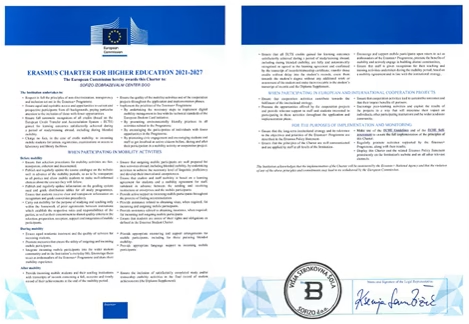
Sofizo Vocational College has been awarded the Erasmus Charter for Higher Education (ECHE) for the period 2021–2027, covering both students and staff.

Students and teaching staff are invited to apply for mobility projects and take advantage of the opportunities Erasmus+ offers for personal, academic, and professional development.

Slika1